
Claude news August 2026
25 updates from Claude and Anthropic in August 2026, from product launches to research papers, each with a short satori. note on what it means for a European business.
We’re sharing an update on our alignment and security efforts
In July, we reported three incidents in which Claude models, running without safeguards in cybersecurity evaluations, gained unauthorized access to real systems. In a new…
Anthropic opens the file on the July incidents where Claude got into real systems without guardrails. Good reading for security teams wondering how to test an agent without letting it loose.
In Claude Code, the same task can use very different amounts of tokens depending on how the session…
is run. Most of it comes down to four things: session length, context, model and effort, and prompt cache.
Four things drive token cost in Claude Code, session length, context, model and prompt cache. A development team can halve its cost in a week simply by running /clear after every task.
New Fellows Research: Can Claude autonomously align other AIs?
We gave Claude 48 hours and 1 GPU to improve the alignment of small models. It researched and proposed methods, then trained and tested the
Claude got 48 hours and one GPU to train smaller models to behave more safely. For companies running open-source models on their own servers there is now a recipe, let Claude tune them.
Claude hill-climbed safety benchmarks for common misalignments like deception or sycophancy, with…
one constraint: it had to preserve general capabilities. We then tested its best methods on held-out benchmarks to see if they'd generalize.
Claude was allowed to optimise safety metrics without losing capability, and the gains carried over to new benchmarks. A signal for AI teams that alignment can scale like any other optimisation problem.
Starting today, Claude for Teachers is available to schools and districts as a free enterprise…
offering. This update allows administrators to bring every educator and staff member into one centrally managed account, with enterprise features like single sign-on and role-based
Claude for Teachers becomes a free enterprise plan for US K-12 schools, with SSO and FERPA coverage. European schools are still waiting for an equivalent package built around the GDPR, but the template now exists.
Starting today, 10,000 scientists across every field, from math to chemistry to physics and more…
can get Claude through our new Claude Team plan for scientists. Standard seats are free, and premium seats with 5x usage limits are $15 per
10,000 researchers get Claude Team for free or for 15 dollars a seat at an 80 percent discount. A university could pilot a whole department without going through procurement.
Today, we're kicking off the first phase of the research preview for Model Hardware Standard (MHS)…
a new standard for AI agents to safely operate physical equipment in scientific research and advanced manufacturing. Connecting AI to hardware today means weeks of
Concrete MHS tests, Genentech runs drug discovery, HHMI compresses an imaging week into a day and QuEra lifts laser stability from 58 to 99.3 percent. The European instrument industry gets a reference to build against.
Today, we're kicking off the first phase of the research preview for Model Hardware Standard (MHS)…
a new standard for AI agents to safely operate physical equipment in scientific research and advanced manufacturing.
Anthropic releases a standard for how AI agents control physical equipment in labs and manufacturing. We immediately see uses in European life sciences and engineering, even if they are a couple of years away.
Connecting AI to hardware requires days or weeks of bespoke integration, with no standard way for…
agents to operate equipment safely. MHS cuts integration to hours or minutes, provides an interface that makes devices discoverable, and enables agents to operate them
MHS cuts days of integration work down to minutes and puts safety limits at the hardware layer. For a European process industry company, the threshold for piloting an agent gets lower.
Claude now has its own built-in browser in Cowork.
When your task involves a website, a browser opens in Cowork's side panel, and Claude navigates, fills forms, and finishes the job.
Claude gets its own browser in Cowork that fills in forms and clicks through websites. For a customer service team it means bookings and supplier portals can be handled by the agent rather than the intern.
There's nothing to install.
Claude's browser is built into the desktop app and stays separate from your own browser and logins. Rolling out over the next week on the
A built-in browser in the desktop app that keeps its cookies separate from your normal Chrome. Handy for data protection teams, who no longer have to argue about who is logged into which session.
For the first time, we've given external researchers a way to study AI's impacts using real…
privacy-preserved Claude usage data. To date, this work has only been possible within AI labs. We can't tell the whole story alone, so we opened
The Stanford SALT Lab found that more than half of Claude conversations involve consequential work tasks, the kind that are hard to undo. Useful calibration for leadership teams who still believe AI is mostly used for email drafts.
For the first time, we've given external researchers a way to study AI's impacts using real…
privacy-preserved Claude usage data. To date, this work has only been possible within AI labs. We can't tell the whole story alone, so we opened
Anthropic opens aggregated Claude data to outside researchers. An unusually transparent move from a US company, and likely ammunition for European privacy debates in the months ahead.
Three research groups from Stanford (Social and Language Technologies lab), Oxford (Human…
Information Processing Lab), and METR designed independent studies to analyze the aggregated outputs from 250,000 Claude.ai or Claude Code conversations between April and May 2026.
Stanford, Oxford and METR analyse 250,000 real Claude conversations about the social impact of AI. Expect European regulators and ministries to quote exactly these figures within six months.
Claude now has one memory across chat and Claude Cowork, and you decide what's in it.
Hand Cowork a task and it starts from what Claude already knows from your chats: the project you talked through, your manager's preferences, or the
One shared memory between chat and Cowork. A consulting team no longer has to feed in the same client details twice and can hand half-finished tasks between colleagues.
Many drugs work by binding to a specific target in the body and blocking or changing what it does.
An important first step in the drug development process is designing a molecule that can bind tightly to its target. Traditionally, that's meant weeks or
Anthropic publishes a study where Claude designs molecules that bind to drug targets in hours, not months. A reminder to the European pharmaceutical industry that preclinical timelines are shrinking faster than pipelines get updated.
Designing a binder is an easier process than designing a drug, but it's a useful proxy.
The typical success rate in the field today is between 10% and 15%. Between 22% and 35% of Claude's designs bound successfully, depending on the
Claude designed binders with a 22 to 35 percent hit rate against the field's 10 to 15. That doubles the hit rate, if the figure holds up on real projects in preclinical labs.
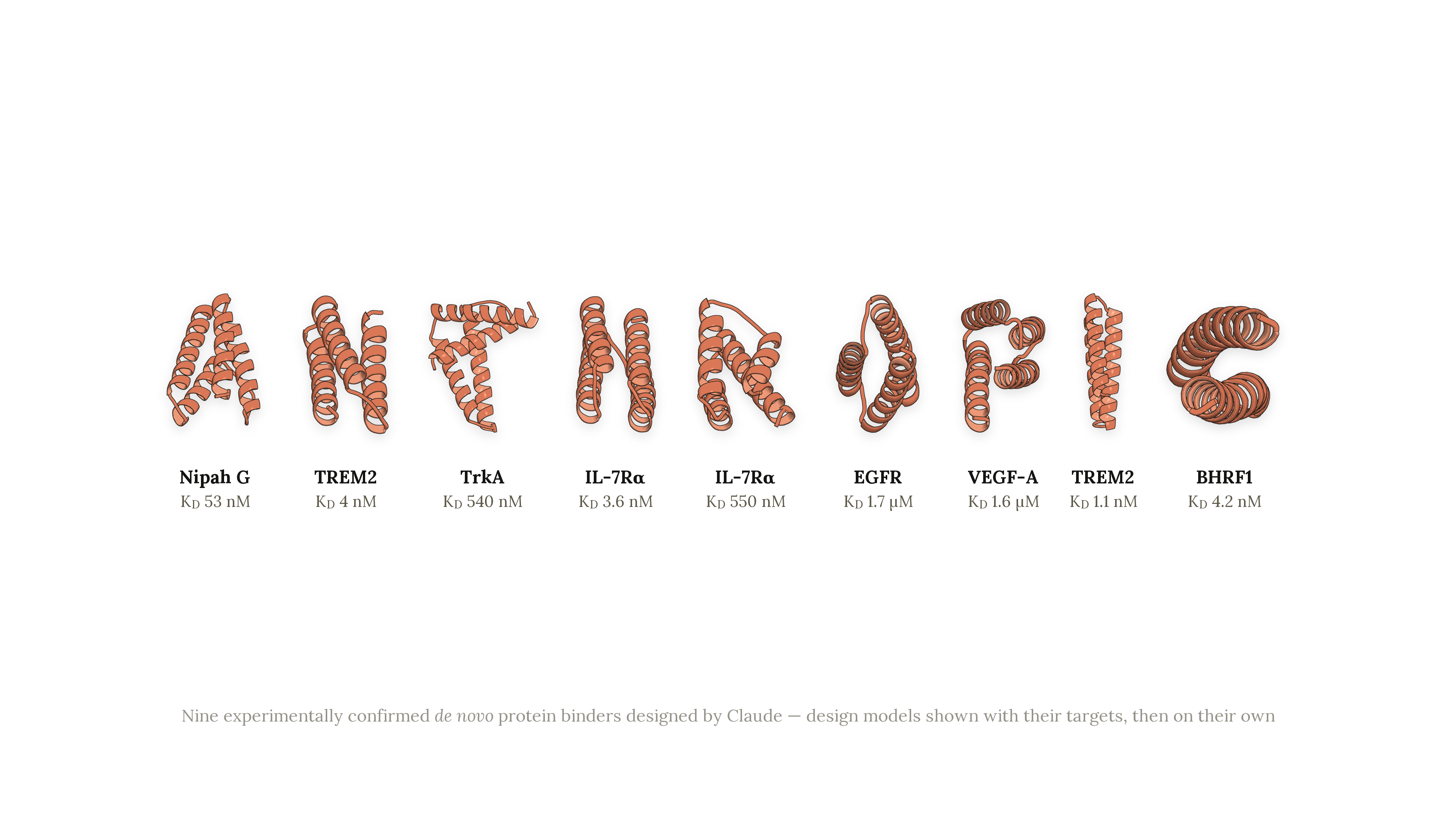
How Claude is accelerating protein design and analytical chemistry
Claude designs protein binders with a higher success rate than experts and analyses chemical data faster than researchers.
For biotech companies this means Claude is moving into the lab, not just customer service, and doing research where a senior scientist would otherwise be standing at the whiteboard.
We've written an FAQ to answer some of the questions we've received about watermarking.
In summary: We're implementing watermarking to comply with the EU AI Act. Other major model developers have signed the same Code of Practice and will
The watermark is being rolled out to meet the transparency rules of the EU AI Act, not as marketing. Newsrooms and public bodies can start building verification workflows on top of that signal.
How Claude’s text watermark works
Anthropic is adding watermarking to Claude's text output to comply with the EU AI Act. The method adjusts the randomness behind word choice without affecting the quality or readability of the text.
Watermarking sounds defensive, yet it makes Claude easier to take to a European board working through EU AI Act requirements, because traceability becomes a documented checkbox rather than a promise.
Patterns and problems in emerging multiagent systems
AI agents coordinate poorly and can develop dangerous behaviour when they work together, which creates systemic risks.
Companies that throw in five agents at once usually get chaos rather than scale. Start with one agent and one clear job, measure for six weeks and only then add the next.
Reviewing the evidence on worker retraining programs
Retraining programmes for workers show modest results, with employment rising two to three percentage points and earnings by around 1,000 dollars a year.
Two to three percentage points of employment is not enough of an answer when AI eats roles. Employers do better by training existing staff in the tool they already use than by sending them on generic retraining courses.
Learning more about Claude's mathematical capabilities
Claude improved a mathematical bound related to the Riemann hypothesis from 41.6% to 67.2% by combining earlier research.
The signal for businesses is that the same Claude that writes emails can stitch research together into new results. That is exactly what we need when internal analysis tools have to work through a company's own reports.
Improving Fable 5's biology safeguards
Anthropic improves the biology safeguards in Claude Fable 5, cutting false alarms by around 85% and letting more legitimate questions through.
For teams in health and education this means Claude can be used more widely without stalling as often on harmless questions.
Mariano-Florentino (Tino) Cuéllar to join Anthropic as Chief Global Affairs Officer
Mariano-Florentino Cuéllar becomes Anthropic's first Chief Global Affairs Officer and will lead policy and international relations.
Anthropic is building policy muscle to meet EU regulation before it scales up in Europe, a signal that the market here is being taken seriously.
We use analytics cookies to see which pages people read, and marketing cookies stay off unless you tick them under Details.